
The Industrial Laundry Washing Machine: A Buyer's Guide

Key Takeaways
Industrial laundry washing machines are high-capacity, heavy-duty units designed for hotels, hospitals, sports teams, and large laundromats processing hundreds of pounds of linens per day, with capacities ranging from 20 to 275 pounds per load.
Automated Laundry Systems supplies, finances, installs, and services commercial washers and dryers across Southern California, including Los Angeles, Orange, Riverside, San Bernardino, and San Diego counties.
Choosing between washer-extractors, soft-mount vs. hard-mount, and top vs. front load models depends on volume, building structure, utilities, and revenue goals.
Smart controls, card and mobile payment systems, and water-saving features can significantly cut operating costs and increase laundromat profitability.
This article will guide you from basic definitions through machine types, applications, selection criteria, financing, installation, and maintenance best practices.
Introduction to Industrial Laundry Washing Machines
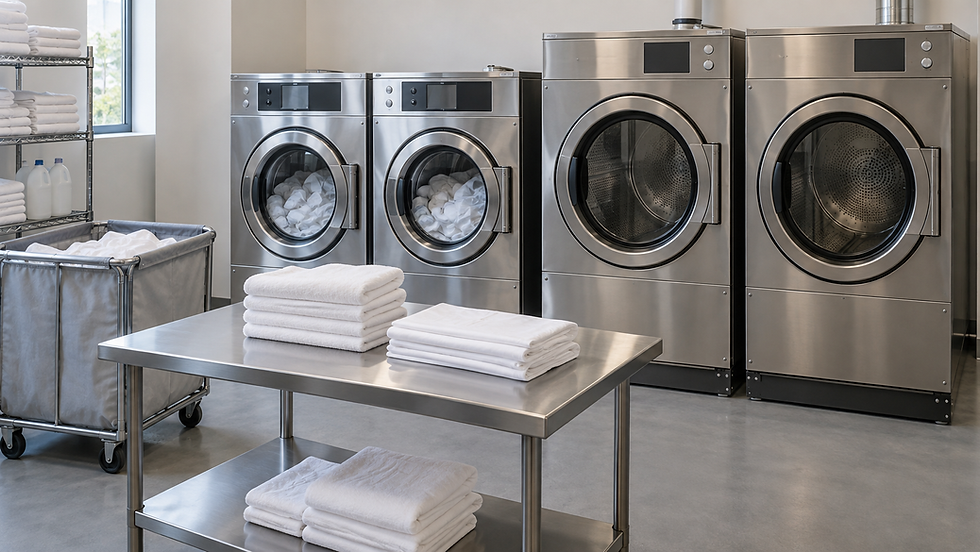
An industrial laundry washing machine is a heavy-duty front-loading unit engineered for high-volume, continuous operation in commercial and institutional settings. These machines built for demanding environments typically handle 20 to 275 lb capacity loads, serving hotels in Los Angeles, hospitals in Orange County, large fitness centers, and professional laundries throughout Southern California. High-capacity industrial washers can handle loads exceeding 700 lbs in a single cycle, far surpassing the capabilities of home washers. Unlike the equipment you might find in a residential setting, industrial washers deliver consistent performance day after day, processing everything from surgical gowns to hotel bedding without compromise.
The difference between industrial machines and residential units comes down to duty cycle, construction, and capability. Industrial washers operate 16 or more hours per day, feature robust components with a long life expectancy of 10 to 15 years with proper service, and are designed for 10 to 15 years of continuous daily use, with some models capable of 8,000 cycles or more. They offer programmable cycles tailored to specific fabric types and soil levels. Higher G-force extraction—often exceeding 200 G—removes significantly more water from textiles, which directly reduces drying time and energy costs. These features ensure that high-volume operations can handle their workload efficiently while protecting the quality of their linens.
Automated Laundry Systems acts as a B2B distributor, lessor, and service provider for commercial and industrial laundry equipment across Southern California. From processing hospital linens at a 24/7 medical center in Riverside to managing hotel bedding along the Anaheim resort corridor, or handling uniforms for sports facilities in Inglewood, the company delivers laundry solutions tailored to each customer’s specific requirements. With advanced programmable cycles and automation, users can leave much of the logistical and manual work to the machine, streamlining operations and saving time. This consultative approach helps customers find the right equipment for their premises while ensuring reliable performance and the lowest total cost of ownership.

Core Types of Industrial Laundry Washing Machines
Industrial washers come in several formats, and understanding the differences helps operators select machines that fit their specific needs. Capacity is often listed in pounds or kilograms of dry linen—for example, a 44 lb (20 kg) machine works well for smaller operations, while 125 lb (57 kg) units serve high-volume laundromats and on-premise laundries. The right choice depends on daily throughput requirements, available space, and building infrastructure.
Hard-mount washer-extractors are bolted directly to reinforced concrete slabs, making them common in ground-floor laundromats across Los Angeles and Long Beach. These machines deliver higher G-force extraction—typically 300 to 400 G—and generally carry lower upfront costs than their soft-mount counterparts. However, they require a properly engineered concrete foundation to handle the vibration generated during high-speed extraction cycles.
Soft-mount washer-extractors feature vibration-dampening systems that allow installation on upper floors or in buildings without reinforced foundations. This makes them ideal for retrofits in dense urban areas like downtown LA or Santa Monica, where poured concrete slabs may be limited or impractical. While soft-mount units typically cost more initially, they offer flexibility that can streamline installation in challenging locations.
Top-load industrial machines generally range from 14 to 27 lb capacities, serving light commercial applications such as small motels, salons, or boutique operations. Front-load industrial washers handle 20 to 100+ lb loads, making them the preferred choice for heavy-duty laundromats, hotel OPLs, and healthcare facilities. Front-load machines built with robust suspension systems deliver superior extraction and accommodate the high cycle counts these operations demand.
Stacked washer-dryer combinations maximize floor space in restricted sites like student housing complexes or compact laundromats in high-rent areas. These configurations pair efficiently sized washers with tumble dryers in a vertical footprint, allowing operators to maintain throughput without expanding their premises.
Washer-Extractors and Tumble Systems
Washer-extractors represent the industrial workhorse of commercial laundry operations, combining washing with high-speed extraction in a single unit. Modern washer-extractors achieve extraction speeds up to 350-400 G, dramatically reducing residual moisture and cutting downstream drying time. This efficiency translates directly to lower energy costs and faster turnaround for busy facilities.
Large operations—such as 200-room hotels in San Diego or 300-bed nursing homes in Ventura County—typically deploy multiple 60 to 125 lb washer-extractors paired with gas tumble dryers. This configuration allows facilities to process substantial daily volumes while maintaining flexibility to run different load types simultaneously. Cycle times typically range from 25 to 45 minutes depending on soil level and fabric type.
Specialty systems like barrier washers serve hospitals and surgical centers requiring strict separation between clean and soiled sides. These machines feature pass-through designs that prevent cross-contamination, integrating seamlessly into cleanroom-style laundries where infection control is critical.
Machine Type | Typical Capacity | G-Force Range | Best Application |
Hard-Mount Washer-Extractor | 40-125 lb | 300-400 G | Ground-floor laundromats, OPLs |
Soft-Mount Washer-Extractor | 20-100 lb | 200-350 G | Upper floors, retrofits |
Top-Load Commercial | 14-27 lb | 80-150 G | Light commercial, salons |
Barrier Washer | 60-200 lb | 300-400 G | Healthcare, cleanrooms |
Industrial Laundry Applications by Sector
Load type, soil level, and throughput requirements differ substantially across hospitality, healthcare, sports, and vended laundromats. Matching machine specifications to sector-specific demands ensures operators achieve the efficiency, reliability, and return on investment their business requires.
Hospitality operations—hotels in Anaheim and Palm Springs processing sheets, duvets, and towels daily—need high-capacity front-load washer-extractors paired with energy-efficient dryers. A typical 100-room hotel generates 600 to 1,000 pounds of laundry per day, requiring machines that can handle this volume while maintaining fabric quality and controlling water and energy costs. Speed and consistency are essential when guest satisfaction depends on clean, fresh linens every time.
Healthcare facilities in Los Angeles and Riverside counties face unique requirements including programmable disinfection cycles, precise temperature control, and optional barrier washers for infection control. Hospitals and clinics must ensure textiles meet stringent hygiene standards while processing high volumes around the clock. Industrial washing machines designed for healthcare applications feature specialized cycles that eliminate pathogens without damaging fabrics.
Sports and fitness facilities—gyms, collegiate athletics programs throughout Southern California—handle heavily soiled uniforms, towels, and training gear requiring fast turnaround. These operations benefit from machines built to handle tough stains and high soil loads while completing cycles quickly enough to meet practice and game schedules.
On-premise laundries for senior living communities, spas, and resorts often choose in-house processing over outsourcing for control and cost management. A 120-bed assisted living facility might operate a 2-3 machine OPL with 60-80 lb washer-extractors, providing reliable service without the variables of external laundry providers.
Vended laundromats with 20 to 40 machines serve dense neighborhoods throughout the region. These operations focus on coin, card, or mobile payments, fast cycle times, and customer comfort. Walk-in customers expect easy operation, clean facilities, and equipment that works reliably every visit.
Laundromats and Multi-Housing in Southern California
Automated Laundry Systems designs and equips coin and card laundromats across Los Angeles, San Diego, and the Inland Empire. Typical installations feature 20 to 80 industrial front-load washers ranging from 20 to 80 lb capacity, complemented by stack dryers sized to match washer throughput. Store layouts account for customer flow, folding areas, and the payment technology preferences of each neighborhood. Incorporating advanced monitoring and payment options can further enhance the customer experience in laundromats.

Multi-housing laundry rooms in apartment complexes, college dorms, and military housing near bases like Camp Pendleton require secure payment systems and durable small-to-medium capacity machines. These shared facilities see consistent daily use from residents who expect equipment availability and straightforward operation. User-friendly management systems now allow operators to oversee laundromat operations from anywhere, improving efficiency and responsiveness.
Space, venting, and utility constraints in older multi-family buildings frequently drive the choice of stackable units and soft-mount machines. A 1960s apartment complex in Long Beach may lack the foundation for hard-mount equipment, making soft-mount washer-extractors the practical path to upgrading the laundry room without structural modifications.
Weekend traffic at vended laundromats often doubles or triples weekday volume, requiring machines that can handle surge demand without breakdowns. Proper sizing and equipment selection account for these patterns, ensuring operators capture maximum revenue during peak hours. When selecting equipment online, customers can easily add offers to their cart, streamlining the purchasing process.
Key Features to Look for in an Industrial Laundry Washing Machine
Long-term ownership cost, uptime, and throughput matter more than purchase price alone for commercial operators. Evaluating features that improve reliability and efficiency helps buyers select equipment that delivers value over a 10-15 year service life.
Mechanical Build Quality:
Stainless steel drums (SUS304 grade) resist corrosion and handle chemical detergents
Industrial-grade bearings and seals withstand continuous operation
Heavy-duty door locks and hinges maintain safety under high-G extraction
Robust suspension systems minimize vibration and extend component life
Commercial washers often incorporate features such as automatic door locks and emergency stop buttons to comply with safety regulations
Control Systems:
Programmable microprocessor or touchscreen interfaces
Programmable controls in modern industrial washers facilitate predictive maintenance through IoT connectivity, allowing remote monitoring of cycle times and energy usage.
Multilingual options (English/Spanish) for diverse staff
Pre-set cycles for towels, linens, uniforms, and medical textiles
Adjustable parameters for water level, temperature, and spin speed
Energy and Water Efficiency:
Automatic weighing systems adjust water to actual load size
Dynamic water levels optimize each cycle
High extraction G-force reduces moisture, cutting dryer energy consumption
Potential utility rebates from California efficiency programs
Modern industrial washers achieve significant savings—processing 100 kg loads with approximately 180 liters of water and 8.5 kWh of energy represents a dramatic improvement over older technology. Operators in Southern California can often qualify for utility incentives that further reduce the effective cost of upgrading to efficient equipment.
Connectivity Features:
Remote monitoring via web dashboards or mobile apps
Real-time data and advanced monitoring enhance efficiency in on-premises laundry operations.
Advanced controls enable quick adjustments to costs based on load sizes and time of day.
Error alerts sent directly to maintenance staff
Data logging of cycles completed for operational analysis
Integration with payment systems or facility management platforms
Many of these features automate or simplify things that would otherwise require manual attention, making operation easier for staff and reducing the burden of routine tasks.
Payment and Revenue-Enhancing Technologies
Coin, card, and mobile payment options for industrial washers in laundromats and shared laundry rooms have evolved dramatically. Contactless and app-based payments introduced widely after 2020 meet customer expectations for convenience while reducing the hard work of coin collection and cash handling for operators.
Advanced payment systems enable time-of-day pricing, extra-charge options for hot water or extended cycles, and loyalty programs that encourage return visits. These features help store owners in the market maximize revenue while building customer relationships.
Remote price adjustment via smartphone or web dashboard lets operators in Los Angeles or Orange County respond to peak-hour demand and local competition without visiting each location. Raising prices slightly on Sunday evenings—when demand peaks and alternatives are limited—captures additional revenue that compounds over time.
The shift to cashless operation also improves security, reduces service calls for jammed coin mechanisms, and provides detailed transaction data for financial reporting. Customers appreciate the simplicity of tapping a card or phone, while operators gain tools to streamline their business operations.
Selecting the Right Industrial Laundry Washing Machine for Your Operation
Automated Laundry Systems works as a consultative partner, sizing and specifying equipment based on real data rather than guesses. This approach helps customers avoid costly over- or under-sizing mistakes while ensuring their investment delivers expected returns.
Capacity Planning Steps:
Analyze daily pounds of laundry by category (sheets, towels, gowns, uniforms)
Identify peak day volume and seasonal variations
Determine desired turnaround time for processed linens
Account for available shifts and staffing per day
Key Constraints to Evaluate:
Electrical service availability (208-240V, 3-phase requirements)
Gas vs. electric heating preference and utility costs
Hot and cold water supply capacity and pressure
Drainage system sizing and location
Ceiling height for stacked configurations
Floor load limits for hard-mount equipment
Building age and layout in Southern California cities significantly impact equipment selection. A 1950s motel in Palm Springs may require different solutions than a new mixed-use development in Irvine. Soft-mount machines and stacked configurations often solve challenges in older buildings, while new construction can accommodate hard-mount washer-extractors with optimal G-force performance.
Site Evaluation Checklist:
Measure available floor space and ceiling height
Document existing electrical service and panel capacity
Verify water supply pressure and pipe sizes
Assess drainage location and capacity
Check floor construction and load-bearing capacity
Identify venting routes for dryers
Review local permit requirements
Brand selection, warranty terms, and service support deserve careful consideration. Automated Laundry Systems provides installation, start-up training, and ongoing preventive maintenance agreements that protect your investment and ensure consistent performance throughout the equipment’s service life.
Designing a New Laundromat or OPL with Automated Laundry Systems
The company helps investors and operators throughout Southern California design store layouts that maximize both efficiency and customer experience. This includes determining the optimal machine mix (small, medium, and large washers), aisle spacing for accessibility, folding table placement, and customer traffic flow patterns.
Typical project timelines range from 60 to 120 days from final design approval to opening, depending on permits and construction requirements in local jurisdictions like Los Angeles or San Diego. Early engagement with Automated Laundry Systems during site selection can identify potential issues before they cause delays.
Coordination with architects, contractors, and local inspectors addresses critical details: venting configurations, gas line sizing, drainage slope and capacity, make-up air requirements, and ADA accessibility compliance. This collaborative approach helps projects stay on schedule and within budget.
Case Example: A recent laundromat build-out in Riverside transformed a vacant retail space into a 32-machine operation with 20-80 lb front-load washers and matched stack dryers. By specifying high-extraction equipment and optimized layout, the facility achieved 15% better throughput than the previous owner’s projections, generating strong revenue from opening day.
Financing and Leasing Options for Industrial Laundry Equipment
Industrial washers and dryers are capital-intensive assets, and many operators prefer financing or leasing rather than paying 100% upfront. This preserves working capital for other business needs while allowing access to the best available equipment.
Leasing Structures:
Fixed-term leases spanning 3-7 years with predictable monthly payments
Options for equipment upgrades at lease end
Potential off-balance-sheet treatment depending on lease structure
Flexible terms based on equipment type and business credit profile
Tax Advantages:
Section 179 deductions may apply in qualifying years
Lease payments often fully deductible as operating expenses
Consult with your tax advisor for current regulations and eligibility
Financing approaches differ for new laundromat start-ups versus established hotels, hospitals, or property managers upgrading aging equipment. New ventures may benefit from lease structures that minimize initial cash outlay, while established businesses might prefer ownership for long-term cost advantages.
Automated Laundry Systems focuses on Southern California businesses, so underwriting can account for regional demographics, utility costs, and local market conditions. This regional expertise helps customers secure appropriate financing based on realistic business projections.
Example Payment Scenarios:
Small OPL package (2 washers, 2 dryers): Estimated $800-1,200/month on a 5-year lease
Full 30-machine laundromat build-out: Estimated $4,500-7,000/month depending on equipment mix and terms
Service, Warranty, and Total Cost of Ownership
Fast, local service in Southern California—same-day or next-day response in Los Angeles and surrounding counties—is critical to avoiding downtime and lost revenue. When a 60 lb washer goes down during peak hours, every hour offline represents real money lost.
Typical warranty coverage for industrial washers includes parts and labor periods ranging from one to five years depending on manufacturer and component. Extended coverage and comprehensive service contracts through Automated Laundry Systems provide additional protection and peace of mind.
The lowest total cost of ownership comes from combining efficient equipment, proper installation, and scheduled preventive maintenance—not simply choosing the lowest purchase price. Machines that cost less upfront but break down frequently or consume excessive utilities quickly erase any initial savings.
Maintenance Success Story: A busy laundromat in San Diego scheduled regular bearing and seal inspections every six months through their Automated Laundry Systems service agreement. During a routine check before Memorial Day weekend—one of the busiest periods of the year—technicians identified worn bearings on two 80 lb washers. Preventive replacement took four hours on a Thursday morning. Without that inspection, both machines would likely have failed during peak weekend traffic, costing thousands in lost revenue and emergency repair charges.
Installation, Safety, and Maintenance Best Practices
Proper installation and routine maintenance directly affect performance, safety, and equipment life for industrial laundry washing machines. Cutting corners during installation creates problems that persist throughout the machine’s service life.
Installation Steps:
Complete site survey verifying measurements and utility locations
Confirm electrical service capacity and circuit availability
Verify floor construction meets load and anchoring requirements
Position machines for optimal workflow and maintenance access
Install dryer venting per manufacturer specifications and local codes
Commission equipment with test loads and verify all functions
Safety Considerations:
Implement lockout/tagout procedures for all service activities
Ensure proper guarding of moving parts and drive components
Train staff on safe chemical handling for detergents and additives
Educate operators on emergency stop procedures and door lock interlocks
Post operating instructions in appropriate languages
Preventive Maintenance Tasks:
Daily: Clean lint screens and filters, inspect for leaks
Weekly: Clean door gaskets, check water inlet screens
Monthly: Inspect and lubricate bearings, verify drain operation
Quarterly: Calibrate controls, test water levels, inspect suspension
Annually: Comprehensive inspection by trained technician

Automated Laundry Systems offers scheduled maintenance programs, expert Fagor washing machine repair service and genuine parts, and technician support across Southern California to keep washers and dryers running at peak performance. Regular service visits identify developing issues before they cause breakdowns, protecting both uptime and equipment investment.
Why Partner with Automated Laundry Systems for Industrial Laundry Equipment
Automated Laundry Systems serves as a full-service partner for commercial laundry operations: equipment distributor, designer, installer, lessor, and service provider focused exclusively on commercial and industrial laundry. This singular focus means the company understands the industry challenges operators face every day.
Geographic Coverage:
Los Angeles County
Orange County
Riverside County
San Bernardino County
San Diego County
The company’s experience spans building new coin and card laundromats from the ground up, retrofitting aging facilities with modern equipment, and upgrading on-premise laundries with industrial washing machines that deliver improved efficiency and lower operating costs.
The consultative approach includes load analysis, utility assessment, ROI modeling, and machine mix recommendations tailored to each site. Rather than offering a one-size-fits-all package, Automated Laundry Systems takes the time to understand each customer’s specific situation, goals, and constraints.
Ready to improve your laundry operation? Contact Automated Laundry Systems today for a site evaluation or equipment quote. Visit the company’s page to learn more about products and services, or search for solutions that fit your specific needs. The team is ready to help you find the right industrial laundry washing machine for your business.
FAQ
How long does an industrial laundry washing machine typically last in a busy operation?
With proper installation and regular maintenance, industrial washer-extractors in high-use laundromats or hotel OPLs commonly operate 10 to 15 years, and in some lighter-duty environments even longer. Hours of daily use, water quality in Southern California (which can be hard in many areas), and adherence to preventive maintenance schedules are the biggest factors affecting lifespan. Investing in durable equipment backed by proper service maximizes your return over the machine’s working life.
What size industrial washer do I need for a 100-room hotel?
A useful rule-of-thumb starts with estimating total daily pounds of linen—typically 600 to 1,000 lb per day for a 100-room property depending on occupancy and service level. This workload might be handled by a mix such as two 60 lb and one 40 lb washer-extractor, allowing flexibility for different load types while maintaining throughput. Automated Laundry Systems can perform a detailed load analysis for hotels in Southern California to fine-tune machine sizes and quantities based on your specific operation.
Can I retrofit industrial washing machines into an older building without a poured concrete slab?
Many older buildings in Los Angeles, Long Beach, or San Diego can still be equipped using soft-mount washer-extractors, which feature vibration-dampening systems that reduce foundation requirements. Structural reinforcement and careful machine placement help manage load and vibration concerns. A site survey is essential to evaluate floor strength, utilities, and venting requirements—Automated Laundry Systems routinely assists with these assessments to ensure successful installations.
Do I have to use coin payment, or can I go fully card or mobile app based?
Modern laundromats and shared laundry rooms in Southern California increasingly use hybrid or fully cashless systems, including card, RFID, and app-based payments for industrial washers and dryers. These systems reduce cash handling, improve security, and meet customer expectations for convenient payment options. Automated Laundry Systems supports multiple payment platforms and can recommend solutions based on your customer demographics and local competition.
How quickly can a new laundromat with industrial washers be opened from concept to first customer?
Realistic timelines range from 3 to 6 months depending on site selection, permitting requirements in your jurisdiction, build-out complexity, and equipment lead times. Some projects move faster when starting with an existing shell space and favorable permit conditions, while others require more time for construction or utility upgrades. Early involvement of Automated Laundry Systems during site evaluation and design can help shorten timelines and avoid costly rework that delays your opening.


Comments